
When the Season Changes, Your Body Notices Too
A shift in temperature, humidity, wind, pollen and daily routines can affect how you feel from one week to the next. You may notice heaviness around the head, changes in nasal comfort, or simply feel that your usual sense of balance has changed.
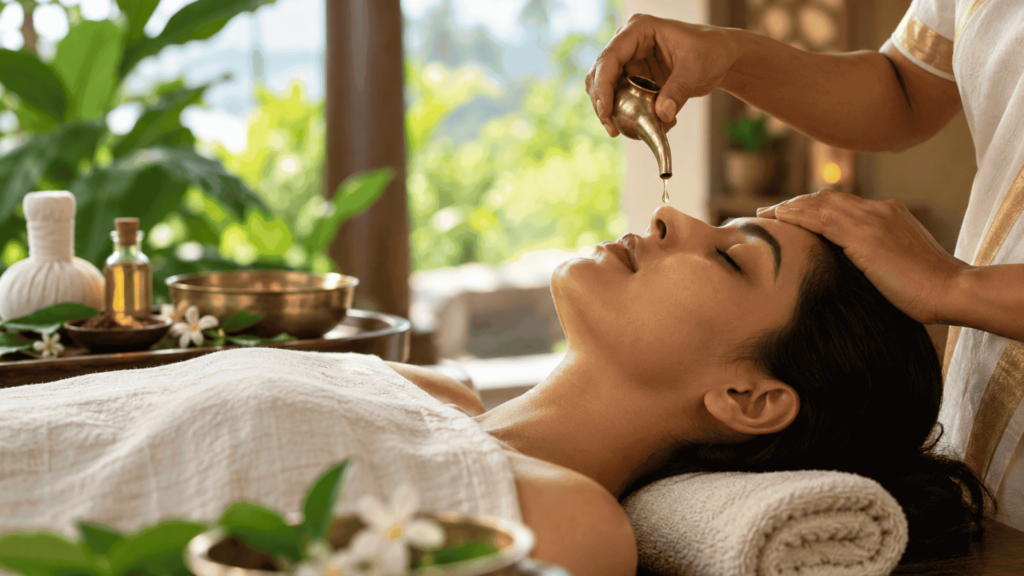
Ayurveda has long placed importance on adapting daily care to nature’s changing rhythms. Nasyam is one traditional practice that may be used as part of Ayurvedic care during seasonal transitions. It involves the careful administration of herbal oil or other prescribed preparations through the nasal passages.
Rather than presenting Nasyam as a quick remedy, Ayurveda views it within a much broader and highly individual approach to wellbeing.
Why Ayurveda Pays Attention to the Seasons
Ayurveda developed around the understanding that we do not live separately from our environment.
As seasons change, so do temperature, moisture, daylight, food choices, sleep patterns, and activity levels. Ayurveda describes seasonal living through Ritucharya, which encourages adjustments in food, routine, movement, and self-care according to the time of year.
This is not about fearing seasonal changes or assuming that every transition requires treatment. It is about becoming more attentive.
How is your digestion feeling? Has your sleep changed? Do you feel unusually heavy, dry, restless, or tired?
These simple observations help an Ayurvedic practitioner understand what support may be appropriate for you.
What Exactly Is Nasyam?
Nasyam, or Nasya, is an age-old Ayurvedic practice involving the administration of a prescribed substance through the nose. Depending on the individual and purpose, an Ayurvedic physician may select specific oils or herbal preparations and determine the appropriate method.
In traditional Ayurvedic practice, the nasal route holds particular importance in care relating to the head and neck region.
Nasyam may sometimes form part of Panchakarma, Ayurveda’s traditional system of purification and restorative therapies. However, Panchakarma is not one standardised cleanse. Classical practice involves different procedures, and practitioners choose them according to an individual’s constitution, current imbalance, strength, age, season, and health needs.
This personalised assessment is an essential part of authentic Ayurvedic care.
Why Nasyam May Be Considered During Seasonal Change
Seasonal transitions can bring noticeable changes around the nose, throat, head, and respiratory passages. Ayurveda interprets these changes according to individual dosha patterns rather than assuming everyone needs the same intervention.
This is where Nasyam during seasonal change may be considered as part of a personalised programme.
Traditionally, practitioners use Nasyam to support balance in the head and neck region. The specific preparation, quantity, and timing matter. What suits one person may not suit another.
For this reason, therapeutic Nasyam should not simply become another wellness trend to copy at home. An Ayurvedic consultation can help determine whether the therapy is appropriate and how it should fit within a wider programme of care.
Panchakarma Is More Than a Modern “Detox”
The word detox has become associated with juices, supplements, restrictive diets, and quick resets. Panchakarma comes from a very different tradition.
Pancha means five, while karma refers to actions or procedures. Panchakarma describes a classical Ayurvedic therapeutic framework in which specific procedures are selected according to the individual’s needs.
Ayurvedic practitioners may use preparatory measures, prescribed therapies, rest, dietary guidance, and gradual post-treatment care as part of the process.
The intention within Ayurveda is not to push the body through an extreme cleanse. Traditionally, practitioners use Panchakarma to address doshic imbalance, support purification processes, and restore balance. Modern scientific evidence for many specific therapeutic claims remains limited, so Panchakarma should complement, rather than replace, appropriate medical care.
The Importance of Preparation and Aftercare
One of the most interesting things about traditional Panchakarma is that the main procedure is only part of the journey.
Ayurveda also gives importance to what happens before and afterwards.
Preparation may involve changes to food and routine alongside therapies chosen by the Ayurvedic practitioner. After treatment, the focus gradually shifts towards appropriate nourishment, rest, and the careful return to normal activity.
This slower approach reflects an important principle: more is not necessarily better.
A traditional Ayurvedic programme should respect your body’s capacity rather than asking it to endure an unnecessarily intensive experience.
The same principle applies to Nasyam during seasonal change. The therapy becomes more meaningful when practitioners consider it within your overall health, season, constitution, and lifestyle.
Rediscovering an Older Way of Caring for Yourself
Modern life often encourages us to respond only when something becomes uncomfortable enough to interrupt our day. Ayurveda offers a different perspective: noticing seasonal changes and adjusting routines as your needs change.
At The Beach House Goa, our Panchakarma Retreat creates the time and environment to explore this traditional approach under professional guidance. An Ayurvedic consultation helps shape the programme around your individual needs. Traditional therapies may then be combined with appropriate nutrition, yoga, meditation, rest, and supportive daily routines.
Rather than approaching Panchakarma as a fashionable cleanse, the experience honours it as an age-old Ayurvedic tradition that requires knowledge, individual assessment, and care.
Nasyam during seasonal change is one example of how Ayurveda encourages us to pay closer attention to the relationship between our bodies and the world around us. Sometimes caring for yourself does not mean searching for something new. It means rediscovering the wisdom of slowing down, observing what has changed, and giving your body the support it needs for the season ahead.
Disclaimer: Our content is not intended to provide medical advice or diagnosis of individual problems or circumstances, nor should it be implied that we are a substitute for professional medical advice. Users /readers are always advised to consult their Healthcare Professional prior to starting any new remedy, therapy or treatment. The Beach House – Goa accepts no liability in the event you, a user of our website and a reader of this article, suffers a loss in any way as a result of reliance upon or inappropriate application of the information hosted on our website.