
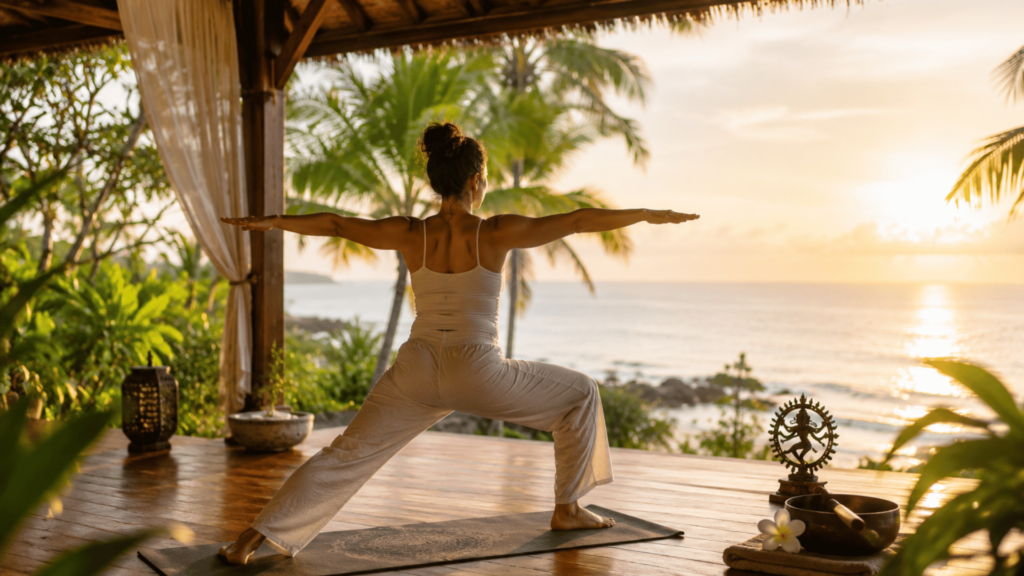
Some Journeys Begin on the Yoga Mat. Others Begin Within
There are days when your body feels strong, but your mind is scattered. At other times, you may long for clarity and motivation yet feel physically tired or disconnected from yourself. Modern life has a way of pulling our attention in many directions. We move quickly from one responsibility to another, often without giving ourselves time to notice how we are feeling.
Ashtanga Yoga offers an opportunity to return to something simpler: movement, breath, attention and repetition.
Through a structured practice, it encourages physical strength and flexibility. It also cultivates qualities that reach far beyond the yoga mat, including patience, consistency, concentration and self-awareness.
What Is Ashtanga Yoga?
The word Ashtanga means “eight limbs” in Sanskrit and traditionally refers to the eight-limbed path of yoga described in Patanjali’s Yoga Sutras. These principles extend beyond physical postures to include ethical living, self-discipline, breath control, withdrawal of the senses, concentration and meditation.
The dynamic practice commonly known today as Ashtanga Yoga follows a structured sequence of postures connected through breath and movement. Sri K. Pattabhi Jois developed and popularised this method internationally during the 20th century.
Unlike yoga classes where the sequence may change each time, Ashtanga practitioners become increasingly familiar with a set series of postures.
And that familiarity has a purpose.
When you no longer need to wonder what comes next, your attention can begin moving inward towards your breathing, your body and the quality of your mind.
Building Strength One Practice at A Time
Ashtanga can be physically demanding, but you do not need to develop strength overnight.
It develops gradually.
Standing postures encourage stability through the legs and hips. Transitions engage the core and upper body. Seated postures develop mobility and control, while balances ask the whole body to work together with greater awareness.
Over time, regular practice may help improve strength, flexibility, balance and coordination.
But perhaps one of its most valuable lessons is learning how to work with your body rather than against it.
You begin to recognise when to challenge yourself and when to soften. When to continue and when to modify. Strength becomes less about forcing the body into a posture and more about developing control, patience and resilience…
The Discipline of Showing Up
Following a familiar sequence repeatedly may initially sound restrictive. Yet repetition is one of Ashtanga Yoga’s most powerful teachers.
The postures may remain relatively consistent, but you don’t.
Your energy changes from day to day. Sometimes the mind feels focused, while at other times the body feels stronger or more open. Learning to practise through these changes becomes part of the journey.
The familiar sequence becomes a way of observing those changes without constantly needing to judge them.
Gradually, you discover that progress doesn’t always come from doing more. Sometimes it comes from simply returning to the practice.
That quiet discipline can begin to influence life away from the mat too. You may approach challenges with greater patience, care for yourself more consistently and keep going even when progress is not immediately visible.
When Breath Gives the Mind Somewhere to Rest
Everyday distractions constantly compete for our attention.
Messages arrive. Deadlines approach. Conversations continue in our heads long after they have finished. Even during moments of rest, the mind can remain busy.
Ashtanga creates a different rhythm.
You coordinate each movement with your breath, giving your attention something immediate to return to. When the mind wanders, as minds naturally do, the breath becomes an anchor.
In this way, the practice can become a moving meditation.
You are not trying to force your thoughts to disappear. You are simply practising the art of returning your attention to the present moment, again and again.
For many practitioners, this creates a sense of mental spaciousness that can remain long after the physical practice has finished.
Yoga is More Than the Posture
It is easy to look at Ashtanga Yoga and notice the impressive physical poses.
But the deeper lessons are often much quieter.
A challenging posture can teach patience.
Slow progress can teach humility.
A difficult practice can teach perseverance.
And a day when your body needs less intensity can teach you to listen.
This is where yoga begins to become more than exercise.
The practice offers an opportunity to observe how you respond when something feels uncomfortable, unfamiliar or beyond your current ability. Instead of immediately judging yourself, you can learn to approach the experience with curiosity.
Over time, the question changes from “How well can I perform this posture?” to “What is this practice teaching me about myself?”
Beginning Your Practice Safely
If you are new to Ashtanga Yoga, it helps to begin with guidance from a qualified teacher.
The structured sequences can be physically demanding, particularly for beginners or those returning to exercise after a break. Learning correct alignment, breathing techniques, and appropriate modifications helps create a practice that feels both safe and sustainable.
Remember that every practitioner begins somewhere. Comparing your journey with someone else’s often distracts from the purpose of yoga, which is personal growth rather than competition.
Consistency will always serve you better than perfection.
Discover Ashtanga Yoga at The Beach House Goa
At The Beach House Goa, our Intense Yoga Retreat offers experienced guidance for those wishing to deepen their yoga practice while reconnecting with body and mind. Traditional yoga sessions, breathwork, meditation, mindful movement, and personalised instruction help guests develop strength, discipline, and greater mental clarity in a peaceful natural setting.
Whether you are beginning your journey or looking to refine an existing practice, the retreat provides the time and space to move beyond daily distractions and reconnect with yourself through consistent, mindful practice.
Because the greatest transformation in Ashtanga Yoga goes far beyond mastering an advanced posture.
You begin to notice it in the strength you build, the discipline you nurture, and the quiet clarity you carry into everyday life.
Disclaimer: Our content is not intended to provide medical advice or diagnosis of individual problems or circumstances, nor should it be implied that we are a substitute for professional medical advice. Users /readers are always advised to consult their Healthcare Professional prior to starting any new remedy, therapy or treatment. The Beach House – Goa accepts no liability in the event you, a user of our website and a reader of this article, suffers a loss in any way as a result of reliance upon or inappropriate application of the information hosted on our website.